Categories
Uncategorized

Honest Worship: Bringing Our Hearts and Our Community Before God

A busy life can make it easy to move through spiritual routines without pausing to examine our hearts. We attend church, hear Scripture, and participate in prayer. Yet a question remains: Are we willing to let God change us?

During a recent prayer-night devotional, I reflected on Ezra 9:5–6 and two closely connected themes: honesty before God and concern for His people. Ezra’s response challenged me to consider both the sincerity of my worship and the people I carry into prayer.

A Restored Temple and a People Still Needing Renewal

Ezra ministered after the Babylonian exile, during the Persian period. The temple had already been rebuilt under the leadership of Zerubbabel and Jeshua, with encouragement from the prophets Haggai and Zechariah. Ezra later arrived as a priest and scribe committed to studying, practicing, and teaching God’s law (Ezra 6:14–15; 7:6–10).

Although the people had returned to their land, they still needed spiritual renewal. Ezra 9 describes covenant unfaithfulness involving marriages with surrounding peoples and participation in their detestable practices.

When Ezra learned what had happened, he grieved. At the evening sacrifice, he knelt, spread his hands toward God, and confessed the community’s sin.

His response invites us to ask how we respond when we recognize compromise in ourselves and among God’s people.

Honest Worship Requires Surrender

Ezra’s posture expressed the seriousness of his prayer. His kneeling and outstretched hands accompanied grief and confession. The challenge for us is to consider whether our outward expressions of worship reflect inward surrender.

Am I honest with God in prayer? Do I want Him to change me? Am I willing to follow His direction when it differs from my preference?

Luke 10:27 describes loving God with our heart, soul, strength, and mind, alongside loving our neighbor. That wholehearted devotion helps us consider how much of our lives we are willing to surrender.

I recognize how easily busyness can carry me through the motions. Work, school, and ministry responsibilities fill the day. I can think about Scripture while still needing to pause and respond to God personally.

Honesty also requires recognizing how we justify wrongdoing. We might describe a misleading statement in a way that makes it sound acceptable or compare ourselves with someone whose actions seem worse.

Different sins can cause different degrees of harm. However, comparison does not remove our responsibility. We need to ask what is true, whom we have hurt, and what obedience requires.

Repentance opens the way to acknowledging our wrong, receiving God’s mercy, and making the necessary change.

Intercession Grows from Shared Concern

In Ezra 9:6, Ezra speaks of “our” sins and “our” guilt. He identifies with the community as he confesses before God.

That shared concern challenges how we respond to struggling people. Do their difficulties move us toward prayer and restoration?

I work with fourth- and fifth-grade students. When they do not listen, frustration comes easily. But am I praying for them? Am I praying for my coworkers, for people who have hurt me, and for fellow believers who are struggling?

First Corinthians 12:26 teaches that members of Christ’s body share one another’s suffering and honor. Intercessory prayer is one way we express that belonging. We carry people’s needs before God because their lives matter to us.

Spiritual growth should deepen our compassion. Prayer, Bible study, and ministry service do not give us grounds to treat others as spiritually inferior. Accountability matters, and its purpose should include helping people move toward repentance and restoration.

We are not walking this walk alone.

Christ’s Sacrifice Gives Us Confidence to Draw Near

Our confidence before God rests on Jesus Christ. He offered Himself for our sins once for all, and through Him we can draw near with sincere hearts and the assurance of faith (Hebrews 10:10–14, 19–22).

Prayer and Bible reading nourish our faith, but they cannot earn redemption or make us superior to others. We receive salvation through Christ and respond to His mercy with obedience.

Romans 12:1 describes that response as offering ourselves as living sacrifices. Christ’s sacrifice redeems us; we offer our lives to Him in gratitude.

As we pray, we can bring both our own need for renewal and the needs of those around us. Ask the Holy Spirit to reveal where surrender is needed and bring someone to mind who needs prayer.

Who needs encouragement? Who needs restoration? What practical act of care can follow your prayer?

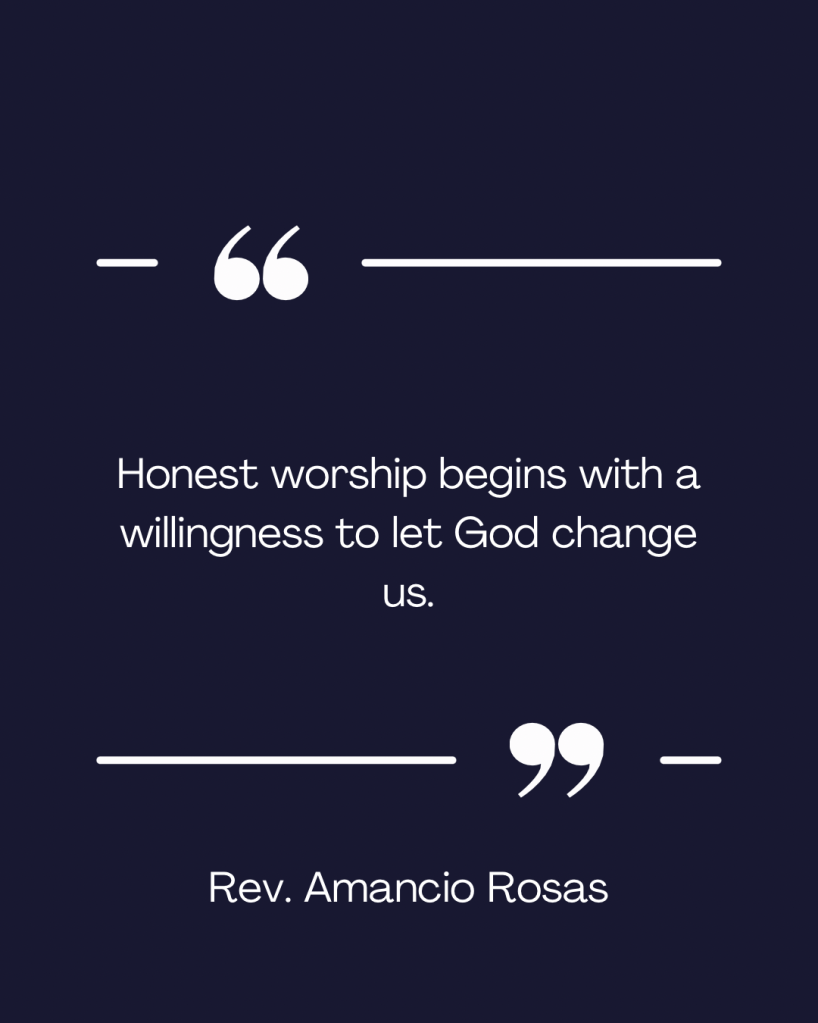
Honest worship brings our whole lives before God. Intercession brings our community with us.
Categories
Personal Journey Uncategorized

Your First Moments Matter

Throughout our journey when it comes to our relationship with God, we can often admit that life can overtake us, creating distractions and hindrances without knowing there’s a disconnect. Busyness and distractions are part of life and are things we must navigate to keep being persistent in keeping God first.

First Encounter:

I remember my first encounter when it comes with my relationship with God. Growing up in religion and developing a religious background, I thought I was all set by pleasing my parents and following the requirements I was told to follow. It wasn’t until God dealt with my hardened heart and learned that my sins could be forgiven by the blood of Jesus Christ that I felt true freedom. Once the altar call was announced, I received a Word about the situation and circumstances in my life. I knew it was time to give my all for Christ, as a sinner, needing His grace and sacrifice for the forgiveness of my sins. I wish I could tell you that everything was rainbow and sunshine but that’s not logical in the Christian Life.

Wrestling:

While reflecting on Jacob’s account, I noticed an important aspect that I would love to highlight regarding the constant battles that we still have to face as imperfect people that God is willing to use for His Glory.

Jacob Wrestling With God. (Genesis 32:22-32)

Jacob was left alone with a man until daybreak. We see wrestling happening when it comes to these two throughout this section of scripture. Jacob was overpowering the individual to the point to where Jacob got his hip wrenched.

1.) Pain is the process of wrestling

Jacob wanted a blessing from God which is why he didn’t want to let go. This shows how much endurance and perseverance Jacob has developed and matured throughout his journey. The fact that he didn’t want to let go and the overpowerment of consistency is what showed his perseverance. Pain was the result but was a reminder of the faithfulness of the blessing. Grace is a free gift but blessings cost because it demands persistence. Brokenness is a reminder of how much we desperately need God to provide for our need.

2.) Jacob’s Name Change

Because of his actions, Jacob, at the time named James, requested a name change. Names are important when it comes to identifying who you are in the Hebrew culture. Jacob means “supplanter” and “deceiver” while Israel means “one who struggles with God.” Due to this encounter with God, Jacob, who was formerly known as Israel, had a transformational encounter with God. While we as believers no longer change our names to prove our character, we can admit that an encounter with God can produce a change of heart and action.

3.) Transformation is Developed through Pain

While a lot of leaders focus on experience to get ahead, it is those who go through pain who receive growth. We want to believe that we will live a happy and fulfilled life as Christians, but pain is part of that experience. You don’t have a change of heart by knowing, but by reflecting and pondering on the condition and willing to be broken by your sin. We tend to fall short, feel guilty, and then ask God to take the guilt away. I think we must embrace the discomfort of our sin and embrace the pain that not only is imparted by us, but the pain that God feels by our shortcomings. Praise God that He is a gracious God, but He does grieve by our actions when we do not comform to His Will.

4.) Transform and Stay Transformed (Genesis 35:9-12)

Jacob had to rededicate himself and his family to God again. One of the beautiful aspects of this is the fact that God wanted Jacob to go back to where they first met (Genesis 28:10-22). God then reaffirmed that His name is now Israel and what He will do in His future generations by the covenant He gave to Abraham and Isaac. I remember my born again experience was full of joy, passion, and excitement. I would assume that Jacob felt the same when he encountered God for the first time at Bethel. He went through a difficult situation where he failed and succeeded. To reaffirm again, he went back to the same spot to rededicate himself as someone who is transformed.

We must have a constant reminder to not only celebrate our victories, but to remain in God’s presence to keep growth and transformation as our focus. When we set our minds to please God, we don’t gratify the desires of the flesh but are following the Spirit. Let us be reminded that no matter the battle, need, or struggle we have, we must go through brokenness to be reminded we need to allow God to transform us.

Categories
Personal Journey

One With The Spirit (Devotional Preview) Day 1

I remembered how I wanted to publish a devotional a year ago. I am now inspired to start this journey to provide a reflective and contextual mix of both devotional and a insight of Scripture. I will post Day 1 and Day 2. While the rest will be published at a later time.

Day 1: Instructions

“He (Jesus) was taken up into heaven, after giving instructions through the Holy Spirit to the apostles he had chosen” Acts 1:2

The ascension of Jesus is the guideline of fulfilling His role to be in the right hand of the Father. Notice here that it’s through the Holy Spirit that Jesus gave instructions to those whom He has chosen which were his apostles. The emphasis I want to make is that Jesus was partnering with the Holy Spirit which we see throughout the gospels. We have no problems seeing the importance of having the Holy Spirit in Jesus’s life and we should reflect that with our own. Our lives should be inviting the Holy Spirit to help us guide and give instructions in whichever area of life we are currently at.

Prayer:

Holy Spirit, guide me to give instructions that are inspired by God to edify, guide, and to move whomever I encounter today. Help me gain an understand of your role to instruct me and those around my circle of influence. Lastly, let me be one with the Spirit, In Jesus name, Amen.